Hand-washing, steam cleaning or dry cleaning: which is safe for Persian and silk rugs?
By The Carpet House team · Updated
For a Persian, silk or other handmade rug, washing it by hand in plenty of cool water is the safest way to get it properly clean. Steam cleaning was made for wall-to-wall carpet, and its hot water can make the colours of a handmade rug run and cause it to shrink or lose its shape [1]. Dry cleaning is gentle, but it mostly cleans the surface and leaves the grit that sits deep inside the rug [1].
Below, we explain how each method works, what can go wrong, and how to choose the right one for your rug.
At a glance
- Hand-washing: cleans right through the rug, uses cool water and a gentle shampoo, and suits Persian, oriental, wool and most silk rugs.
- Steam cleaning: quick and fine for wall-to-wall carpet and many synthetic rugs, but the heat is risky for handmade and silk rugs.
- Dry cleaning: uses little water and dries quickly, but it mostly cleans the surface.
- Whatever the method: the colours should be tested first, and the rug must be dried completely.
What is the difference between hand-washing, steam cleaning and dry cleaning?
Hand-washing means soaking the whole rug in water, washing it with a mild shampoo and scrubbing it by hand. The dirty water is then pushed out, and the rug is rinsed until the water runs clear. It is done at a workshop, not in your home, because the rug needs space and time to dry properly.
Steam cleaning (also called hot water extraction) uses a machine that sprays hot water and cleaning solution into the carpet and sucks it straight back out. It is usually done in your home, and the carpet stays damp for a few hours afterwards.
Dry cleaning uses very little water. A cleaning powder, foam or pad is worked into the surface of the rug to pick up the dirt, and then vacuumed or wiped away.
How do the three methods compare?
| Hand-washing | Steam cleaning | Dry cleaning | |
|---|---|---|---|
| How deep it cleans | Right through to the base of the rug | Made for thinner wall-to-wall carpet; may not reach dirt deep in a thick rug [1] | Mainly the surface [1] |
| Water temperature | Cool or room temperature | Hot | Little or no water |
| Risk of colours running | Low, because colours are tested first and no heat is used [3] | Higher, especially in older rugs [1] | Low |
| Risk of shrinking or losing shape | Low when done by people who know rugs | Possible with handmade rugs [1] | Low |
| Leftover soap or residue | Rinsed out until the water runs clear | Some can stay in the rug | Can build up and make the rug get dirty faster [1] |
| Drying | Several days, until fully dry | A few hours, often in the home | Quick |
| Best for | Persian, oriental, wool, silk and antique rugs | Wall-to-wall carpet and many synthetic rugs | A light refresh between washes |
Swipe sideways to see the whole table.
Is steam cleaning safe for a Persian rug?
It is not the safest choice. Steam cleaning machines were designed for wall-to-wall carpet, which is less dense than a handmade rug [1]. A hand-knotted rug (made by hand, one knot at a time) is thick and tightly packed, and fine grit settles deep at its base, where a steam cleaning wand struggles to reach.
The hot water is the bigger concern. Many Persian and oriental rugs are coloured with traditional dyes, and warm water can make the colours of older rugs run into each other [1]. Heat and too much water can also make a handmade rug shrink or warp [1]. Once colours have run or a rug has shrunk, it is often difficult and expensive to put right.
There is one more problem in Singapore. Our air is humid all year round: the average relative humidity is around 80% [5]. A thick rug that stays damp after cleaning can start to smell and grow mould, and textile conservators advise getting wet textiles fully dry within about two days [4]. A rug that feels dry on top after a steam clean can still be wet underneath.
What about silk and “art silk” rugs?
Real silk rugs need the most care of all. Silk is delicate, conservators advise handling it as little as possible when it is wet [4], and some silk rugs have dyes that run easily. A real silk rug can be washed with water, but only gently, by people who test the colours first.
Many rugs sold as silk are actually art silk, also called viscose or bamboo silk. This is a man-made fibre that looks shiny like silk but is much weaker when wet: viscose can lose 30 to 50% of its strength while it is wet, and hot water can make its colours bleed [2]. Rubbing it hard, using hot water or soaking it for too long can leave it fuzzy, matted or stained.
If you are not sure whether your rug is real silk or art silk, tell us when you ask for a price. We check every rug before washing and adjust how we wash it.
Is dry cleaning a gentler option?
Dry cleaning is gentle on the rug because it uses so little water, and it dries quickly. The trade-off is that it mainly cleans the surface [1]. Sand, dust and grit that have worked their way down to the base of the rug stay there, and over time that grit wears the fibres like fine sandpaper.
Because most dry methods don’t rinse the rug, cleaning products can also build up over repeated cleans, which can make the rug get dirty again faster [1]. Dry cleaning is fine for a light refresh, but it is not a replacement for a proper wash.
How do we wash handmade rugs?
Every rug goes through the same six steps:
- Inspection and colour test. We check what your rug is made of and test a small spot to make sure the colours won’t run. Museum conservators do the same before any wet cleaning, because washing cannot be undone [3].
- Vacuuming. We lift the dust and grit that sit on the surface before any water touches the rug.
- Soaking and hand-washing. We soak the whole rug in water, wash it with a gentle, wool-safe shampoo that has no bleach, and scrub it by hand.
- Rinsing with a rake. We flush the rug with fresh water and push the dirt and soap out with a traditional metal rake, until the water runs clear.
- Drying. We dry the rug in natural sunlight, or indoors with large air blowers in bad weather, until it is fully dry right through.
- Final check and delivery. We check the rug front and back, then bring it back to your door.
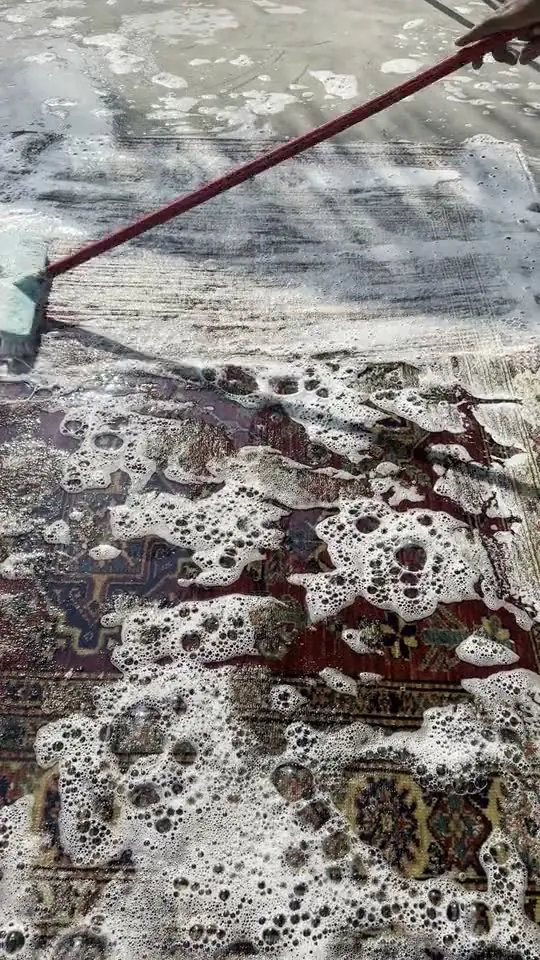
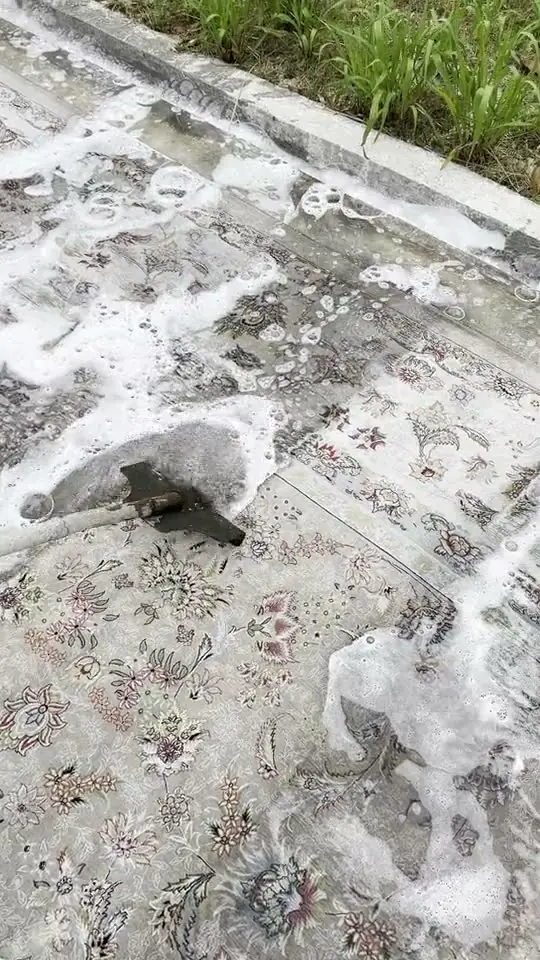
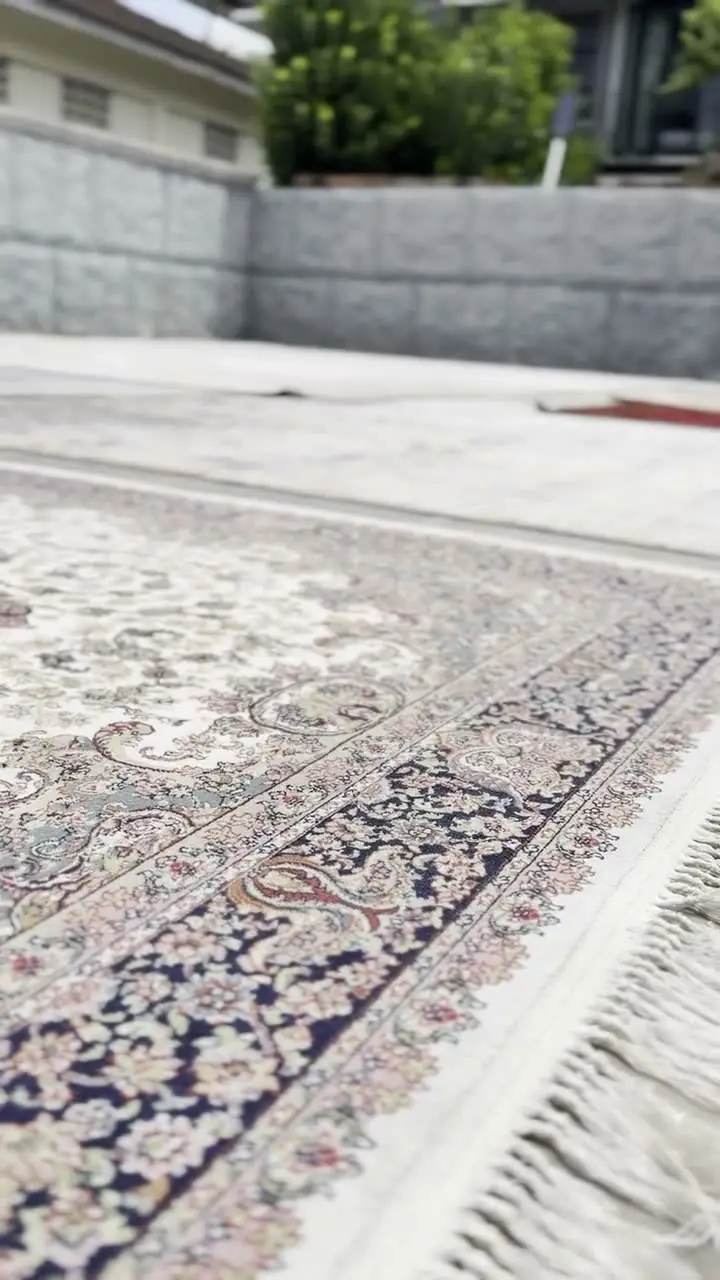
The only machines we use are the vacuum and the drying blowers. Everything else is done by hand. You can see each step on our rug washing page.
When is steam cleaning fine?
Steam cleaning is a sensible choice for wall-to-wall carpet in homes and offices, and for many machine-made synthetic rugs, such as polypropylene or nylon. These are made to handle heat and water and are not dyed in the traditional way.
We don’t clean wall-to-wall carpet. We only wash loose rugs, at our own facility.
Signs a rug was cleaned the wrong way
These are the problems we see most often in rugs that come to us after being cleaned elsewhere:
- colours that have run into the lighter areas
- a rug that feels stiff, rough or sticky
- a musty or damp smell that won’t go away
- edges that curl, or a rug that no longer lies flat
- shiny fibres that now look fuzzy or matted (common with art silk)
Some of these can be improved with a careful wash or repair. Send us photos and we’ll tell you honestly what we can do. See our repair and restoration page for more.
Common questions
References
- Consumers’ Checkbook, “In-Plant Rug Cleaning”. https://www.checkbook.org/national/carpet-and-rug-cleaners/articles/In-Plant-Rug-Cleaning-5679
- Cleanfax, “Rayon: The fiber that just won’t go away”. https://cleanfax.com/rayon-the-fiber-that-just-wont-go-away/
- Canadian Conservation Institute, CCI Notes 13/14, “Testing for Colourfastness”. https://www.canada.ca/en/conservation-institute/services/conservation-preservation-publications/canadian-conservation-institute-notes/testing-colourfastness.html
- U.S. National Park Service, “Preservation Matters: Saving Wet Textiles after a Flood”. https://www.nps.gov/articles/000/preservation-matters-disasters-saving-wet-textiles-after-a-flood.htm
- National Environment Agency (via data.gov.sg), “Relative humidity: annual mean”. https://data.gov.sg/dataset/relative-humidity-annual-mean